


National Geographic 1997 September
Publisher: National Geographic
Format: Paperback
ISBN: none
Welcome to National Geographic, September 1997 (Vol. 192, No. 3) — a gloriously late-90s issue where the yellow border is crisp, the photography is cinematic, and the magazine’s idea of a gentle read is “let’s put you in a fast river with a man in wet shorts and then casually discuss the future of entire regions.”
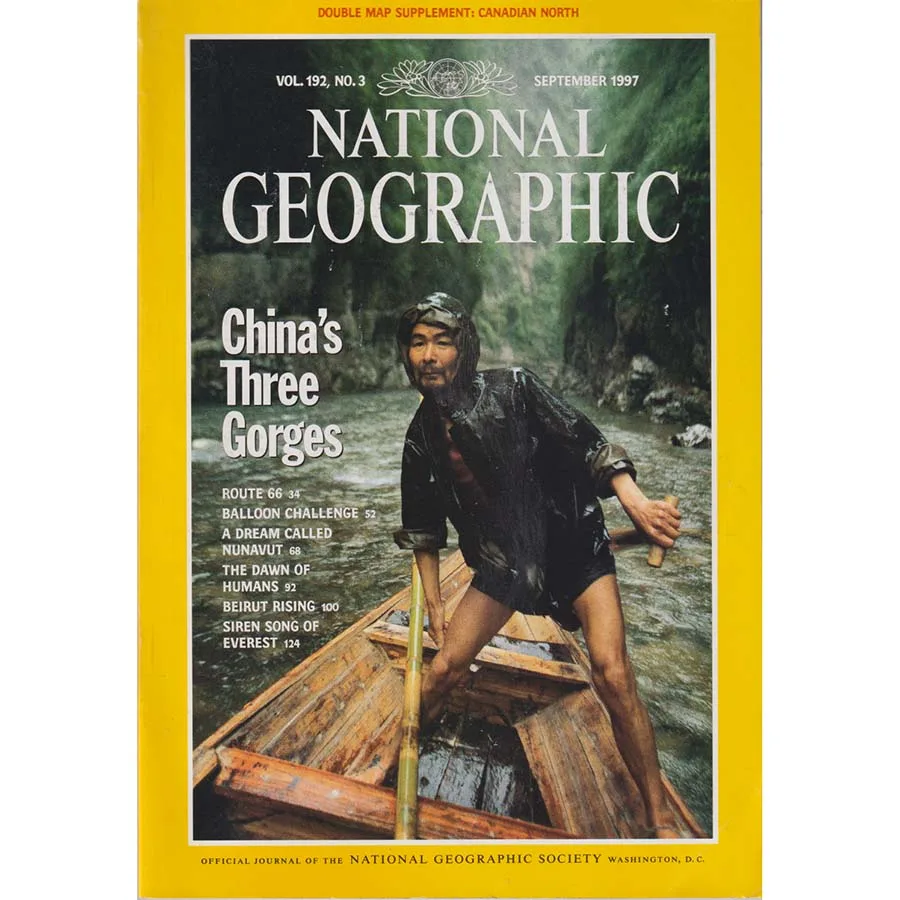
The cover headline is China’s Three Gorges, delivered with that calm Nat Geo confidence that says: Yes, we’re going to explain an enormous landscape, a monumental engineering project, and the human consequences — and we’re going to do it with gorgeous pictures so you’ll thank us for the emotional complexity. The cover image is pure damp determination: a boatman braced in a narrow craft, water everywhere, the kind of scene that makes your sofa feel like a miracle of modern comfort.
And right at the top is the extra treat: DOUBLE MAP SUPPLEMENT: CANADIAN NORTH. Because nothing says “September 1997” like opening your magazine and finding a huge fold-out that quietly turns your living room into a cartography lab. National Geographic didn’t just want you to read about places — it wanted you to own them in paper form, to spread them across a table and become the sort of person who points at remote regions while saying things like “Ah yes, Nunavut.”
Inside, the issue is classic Nat Geo variety theatre — one part serious geopolitics, one part adventure, one part history, one part “why are humans like this,” all stitched together with beautiful writing and that steady editorial voice.
The main feature on China’s Three Gorges is big, dramatic, and full of that “before and after” tension. River gorges aren’t just scenery here — they’re livelihoods, homes, history, trade routes, myths, and a very physical reminder that when humans decide to reshape nature, nature doesn’t exactly vote on it. It’s the kind of piece that makes you marvel at scale while also feeling that small, prickly sense of, This is complicated, isn’t it? (It is. Nat Geo loves complicated.)
And then, because attention spans are a resource too, you’re immediately whisked into the rest of the contents list like a well-organised whirlwind:
-
Route 66 — a hit of Americana nostalgia, the road-trip mythos served with diners, dust, and that sweet feeling of motion without consequences.
-
Balloon Challenge — the specific flavour of human ambition that says, “What if we did something difficult and weather-dependent, in a basket, for glory?”
-
A Dream Called Nunavut — timely, northern, political, and quietly moving: identity, self-determination, and the creation of a place on the map that is also a statement. Bonus points because it pairs beautifully with your Canadian North map supplement, like Nat Geo planned your whole evening.
-
The Dawn of Humans — because why not casually throw in the origin story of our species while you’re at it?
-
Beirut Rising — a sober, resilient piece about a city rebuilding and reimagining itself, delivered with the magazine’s trademark mix of empathy and wide-angle context.
-
Siren Song of Everest — for anyone who enjoys the genre of “why would you do that?” answered with, “Because it’s there,” plus thin air and big consequences.
Condition: Good, meaning it’s pre-loved but sturdy — ready to be read, admired, and dramatically unfolded (especially the map) without immediately disintegrating into historical confetti. Expect that honest vintage feel: slightly lived-in, still handsome, still very capable of swallowing an entire afternoon while you learn about dams, deserts, new territories, ancient ancestors, and the irresistible pull of tall mountains.
If you want a single issue that captures the 1997 Nat Geo sweet spot — big world stories, big travel energy, big maps, and just enough existential texture to make you feel like you’ve done something worthwhile — September 1997 is a cracking pick. Sold by Crappy Old Books, naturally: providers of second-hand wonder and fully unfoldable northern geography.
Keep browsing: See more National Geographic books Other books by National Geographic
